Major Arcana · Rider–Waite–Smith
Is Justice a Yes or No?
Justice is a Maybe upright and a Maybe reversed. The card answers yes only when the request is fair and the facts are in. Reversed, bias or a snag blocks a clean result, still without handing you a simple no.
Yes No Tarot card library · Published 2026-10-21 · Updated 2026-11-15
Upright
Reversed
The free reading on the homepage draws three Major Arcana cards, including this one, and answers the question you type. It does not lock a single card into the spread.
Upright in a yes or no reading
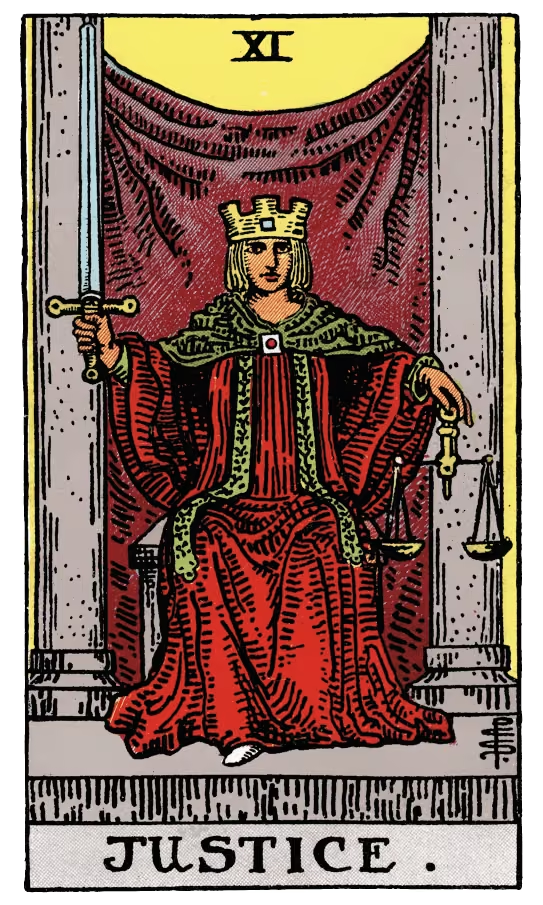
Scales and an upright sword, seated between pillars. Upright Justice is consequence matched to conduct: a decision on the merits, a contract honored, a truth told in proportion. That cannot be a blanket Yes, because the card does not care whether you want the outcome. It cares whether the outcome is deserved. If your question is “will I get this if I have actually met the standard?”, the leaning is yes. If the question is “can I get this while skipping the standard?”, the leaning is no. The single label that survives both questions is Maybe, conditioned on the facts. Bring the evidence. The sword cuts the story down to what can be shown.
Reversed in a yes or no reading
Reversed Justice is bias, excessive severity, or a complication in getting a fair result. You might be the one holding the bent scale. The outcome you named is not dependable, which is a Maybe rather than a theatrical No: a delay, an appeal, a missing document, a judge — literal or figurative — who has already picked a side. Do not read it as “cheat and win,” and do not read it as “the universe will punish you.” Read it as: the process is not straight, so a yes would be a guess. Fix the imbalance you can reach. If the forum itself is crooked, the card does not promise a rescue inside it.
Love
Upright asks for an even account. A Yes to reconciliation or commitment appears only if both people can name what happened without a speech for the defense. Reversed, someone is keeping a private score, or a consequence is harsher than the act. Maybe. Fairness in love is not a court you win. It is a conversation where the scales would not embarrass you if the other person held them.
Career
Upright supports processes: applications judged on criteria, reviews, licenses, formal complaints with a record. Maybe, tipping to yes when your case is documented. Reversed warns of politics, a biased panel, or your own spin. If you need a legal prediction, talk to a lawyer. The card is a picture of fairness, not a ruling.
Money
Upright is a Maybe that favors the documented, proportional deal and disfavors the one that only works if nobody reads it. Reversed is a reason to pause: hidden terms, a penalty out of scale, an invoice dispute. Get the paper. Justice does not pick an investment and does not guarantee you will be paid because you were right.
A common misread
Justice is not a Yes because you feel wronged, and reversed is not a curse. Upright weighs the case. Reversed says the weighing is off. Both are Maybes until the facts are straight.
Common questions
Is Justice a yes or no card?
Maybe. Upright says yes only if the outcome is fair and supported. Reversed, a bias or a snag means you should not count on a clean result either way.
Does Justice reversed mean I will lose?
It means the process is slanted, delayed, or overly harsh. That is a Maybe, not a sentence. Correct what you can document, and get proper advice for a real legal matter.
Is Justice a yes for getting what I deserve?
Only in proportion to the facts. The card supports a deserved outcome and refuses a desired one that the record does not carry.
Related cards
Related reading
- Shall I express my feelings to him/her? — Yes or No🔮Figure out if you should express your feelings through insightful yes or no tarot readings. Explore love's journey with clarity and guidance.
- The Ultimate Guide|How to Do a 3-Card Yes or No Tarot ReadingDiscover how to perform a 3-card yes or no tarot reading for clear insights and guidance on your questions.
These are reflective leanings in the Rider–Waite–Smith tradition. They are not medical, legal, or financial advice, and they do not guarantee an outcome in love, work, money, health, or law.
The verdicts on this page come from the card’s Rider–Waite–Smith imagery and the rules set out under how these verdicts are assigned.